
Pinpointing Emergencies: How GNSS-Enhanced AML Transformed Sweden’s 112 Response
SOS Alarm
SOS Alarm is Sweden’s national emergency services operator, responsible for handling all 112 calls, coordinating police, fire, ambulance and public warnings across the country, as well as playing a role in civil defense. They hold a central role in national crisis preparedness, using situational analyses, extensive information flows and advanced technology to manage alarms and coordinate Sweden’s aid efforts during accidents, crises and societal disruptions. Their work aims to strengthen the Swedish safety chain while driving rapid incident response, crisis communication and safety innovation. They have an interest in space-related technologies to enhance both response times and nationwide public safety.
The challenge
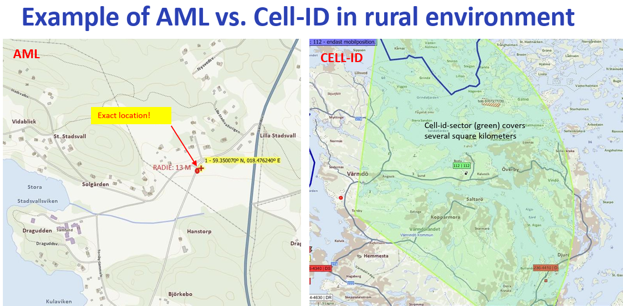
The two most important information for SOS Alarm are what happened and where. Before 2019, the callers were located through Cell-ID from mobile operators, which had significant limitations: depending on density, the coverage area varied between 500 meters up to 2 kilometers, making precise positioning difficult. This slowed response times for 112 callers in accidents, incidents or when locating lost persons. In addition, Sweden’s vast rural, mountainous, and coastal regions often lacked mobile coverage, creating further challenges for situational awareness and rapid response. There was also no reliable redundancy in case of network outages, limiting the ability to communicate with people during emergencies.
The satellite solution
In 2019, SOS Alarm implemented Advanced Mobile Location (AML), which uses smartphones’ global navigation satellite system, Wi-Fi, and cell network data to provide precise caller locations. Its accuracy, within 15 to 65 meters, allows emergency services to locate incidents in real time, even without detailed information from the caller. This is particularly effective in road traffic accidents and outdoor emergencies.
Building on this, SOS Alarm will implement satellite-based communication for mobile phones in 2026, enabling text-based emergency messaging even when terrestrial networks fail due to power outages or network issues. This approach provides redundancy in remote areas and ensures that first responders and alert centers remain connected under extreme conditions.
The results
AML is used in approximately 82% of mobile calls where someone needs assistance. With the integration of AML and satellite-assisted communication, 112 callers can now be precisely located, reducing search areas from kilometers to just meters, and significantly improving response times. It also lowers caller stress, as they no longer need to describe their location, resulting in clearer communication and fewer errors during emergencies. This accuracy is especially valuable in remote areas, where it enables faster and more targeted emergency response.