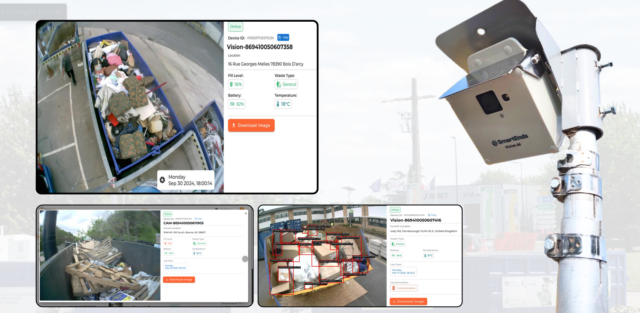
Transforming Waste Management Through Smart Technology
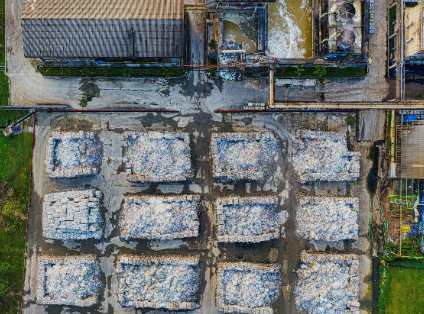
SmartEnds
SmartEnds is a Belgium-based company that combines smart sensor technology supported by space-based solutions with artificial intelligence to optimise waste collection and reduce landfill waste.
The challenge
The global waste management industry is expected to reach $2.3 trillion by 2030, yet much of it still relies on analogue systems. Traditionally, waste collection systems operate on fixed schedules, following rigid one-size-fits-all models. Trucks operate on fixed schedules, regardless of whether bins are overflowing or nearly empty, a practice that has become increasingly outdated and inefficient.
The consequences of this approach are significant:
- Overuse of fleets and personnel, leading to inflated operational costs.
- No real-time visibility into bin status, resulting in missed overflows or unnecessary pickups.
- Lack of automation, making it impossible to optimise routes or track performance.
- Limited data on bin locations and contents, especially in large or remote areas.
The solution
To tackle these challenges, SmartEnds introduced a cutting-edge waste management system powered by IoT sensors, smart cameras, and AI-driven software. Their technology is designed to work across a wide range of bin types, from compact city bins to massive industrial containers.
Key innovations include:
- Sensor Integration: These smart sensors detect fill levels, last collection time, and even the type of waste, flagging hazardous materials when necessary.
- Smart Cameras: Visual verification tools help ensure recycling quality and detect contamination.
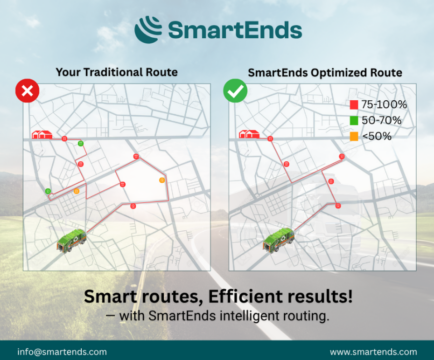
- Software Optimisation: All data is fed into a central platform that calculates the most efficient collection routes, reducing fuel consumption and labour hours.
Regarding the space components, two are the main solutions which are integrated in these systems, supporting the overall activities and innovations: the first is Spatial Intelligence with GNSS (Global Navigation Satellite System), which enhances location accuracy, especially for large or mobile containers.
And the second one is about Advanced Connectivity, especially in remote or rural zones, where satellite communication ensures uninterrupted data flow.
The results
Implementing these technologies has empowered users to achieve:
- Fleet Reduction: Translating into lower fuel costs and reduced emissions.
- Environmental Gains: In most cases, optimised routing has led to a 30–40% reduction in road usage, easing traffic congestion and cutting carbon output.
- Operational Efficiency: Collection is faster and more accurate, with fewer missed pickups and less overflow.
- Cost Savings: Municipalities and private companies report at least 30% savings in operational costs thanks to smarter route planning and better resource allocation.