Bridging Space and Ocean: Key Insights from Eurisy participation to the 3rd Ocean Space Forum in Monaco
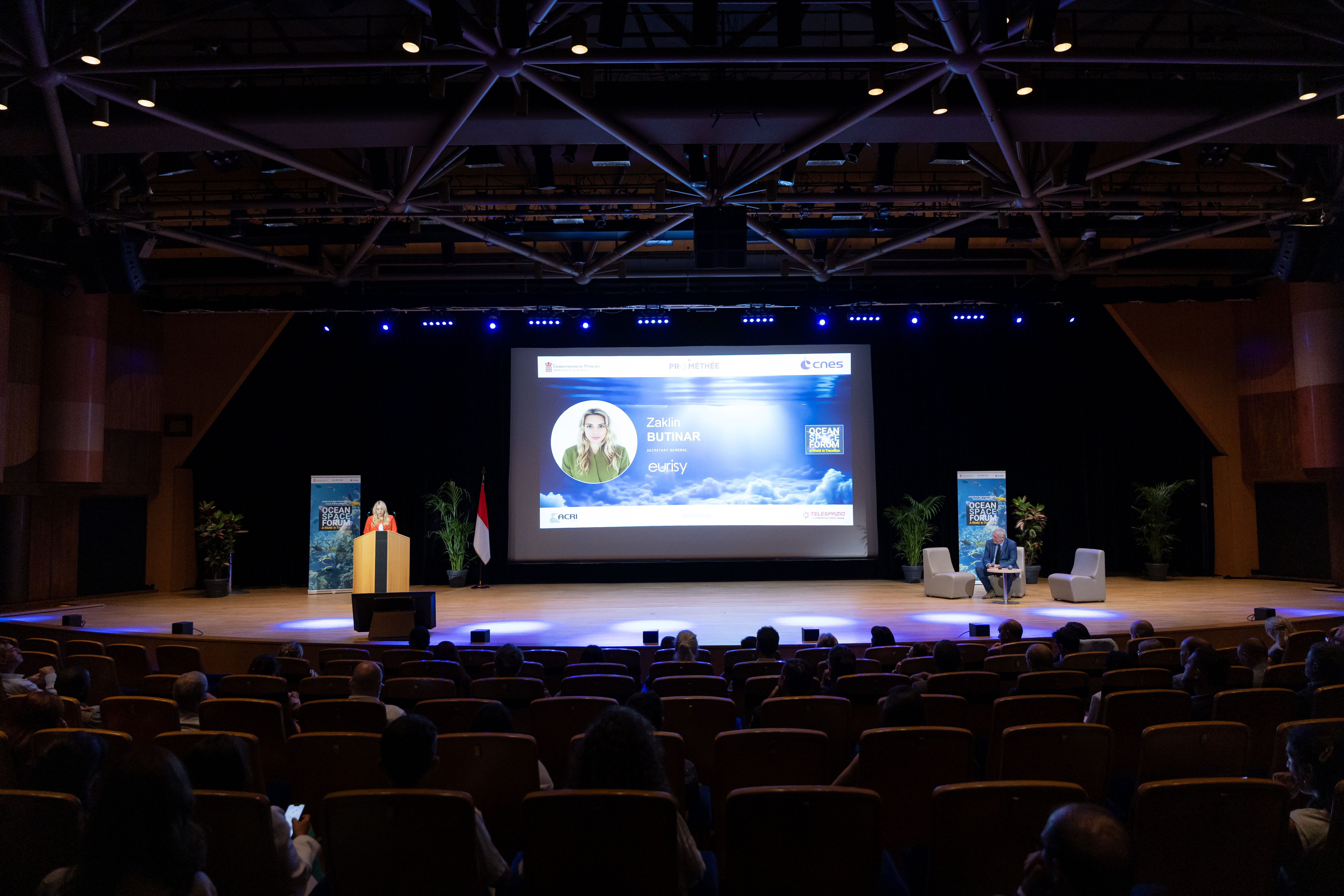
On 2 July, Eurisy had the pleasure of attending and contributing to the third edition of the Ocean Space Forum in Monaco. Held under the High Patronage of H.S.H. Prince Albert II of Monaco, the Forum was organised by the Princely Government of Monaco through its Space Affairs Office, the French National Centre for Space Studies (CNES) and Prométhée Earth Intelligence.
Bringing together policymakers, international organisations, space agencies, researchers and industry representatives, the event examined common challenges and opportunities at the intersection of the space and ocean sectors through six roundtables organised around three overarching themes: the climate crisis and its impact on the ocean, law enforcement and ocean governance, and technological opportunities.
In her opening remarks, Isabelle Rosabrunetto, Director General of the Ministry of Foreign Affairs and Cooperation of the Principality of Monaco, highlighted Monaco’s longstanding commitment to both ocean protection and space innovation, building on the vision initiated by Prince Rainier III. She stressed that international cooperation and technological innovation must go hand in hand to address today’s maritime challenges.
Olivier Piepsz, Chairman of Prométhée Earth Intelligence, then set the tone for the discussions by underlining that the ocean has become not only an environmental concern, but also a geopolitical and economic one. As maritime activities continue to expand, he argued that effective observation has become indispensable: “We cannot protect what we cannot observe.” Satellites have become the “eyes of the planet”, supporting applications ranging from maritime surveillance and pollution detection to sea-level monitoring, critical infrastructure protection and disaster response. Yet technology alone is not enough. A recurring message throughout the Forum was that financing and coordination remain the key obstacles to scaling successful pilot projects into long-term operational services.
Reflecting this multidisciplinary approach, the Forum brought together representatives from international organisations including the United Nations Office for Outer Space Affairs (UNOOSA), the United Nations Office on Drugs and Crime (UNODC), UNESCO’s Intergovernmental Oceanographic Commission (IOC), the World Meteorological Organization (WMO) and ACCOBAMS, alongside space agencies such as ESA, CNES, the Italian Space Agency, the Maldives Space Research Organisation and the Senegalese Space Agency. They were joined by research institutions, private companies and organisations such as Eurisy and POGO, creating a unique platform for dialogue between the space and ocean communities.
Keynote: The Climate Crisis and the Ocean
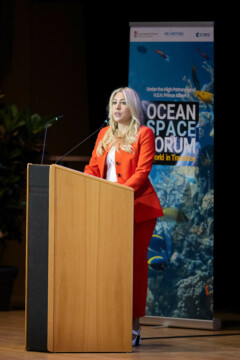
Opening the Forum’s first thematic session, Eurisy’s Interim Secretary General, Zaklin Butinar, highlighted the profound impact of climate change on the world’s oceans and the growing role of space technologies in supporting adaptation and resilience.
She reminded the audience that the oceans have absorbed more than 90% of the excess heat generated by climate change since the 1970s. While this has limited atmospheric warming, it has come at a significant cost: marine heatwaves, ocean acidification, harmful algal blooms, shifting fish stocks, sea-level rise, coastal erosion and increasingly frequent extreme weather events are placing unprecedented pressure on marine ecosystems, coastal communities and maritime activities.
Against this backdrop, she argued that satellite-based services already provide practical tools to monitor these evolving challenges, from environmental observation and oil spill detection to iceberg tracking and maritime safety. However, technological innovation alone is not sufficient. Successful adoption depends on understanding the operational needs of public authorities and end users, involving them throughout the service development process and strengthening collaboration between the space and maritime communities.
Presenting Eurisy’s role as a facilitator between these sectors, she illustrated how the organisation supports the uptake of satellite-based services through user engagement, international workshops and the promotion of operational success stories. Concluding her keynote, she emphasised three key messages: space technologies are already contributing to climate resilience; end users must remain at the centre of innovation; and stronger dialogue between the space and ocean communities is essential to transform existing solutions into lasting societal impact.
A Roundtable moderated by Eurisy
Roundtable E: Common Challenges, Solutions and Success Stories in Space and Ocean Technology
Later that day, the roundtable on Common Challenges, Solutions and Success Stories Involving Space and Oceanic Technological Development explored how space technologies are becoming key enablers for maritime security, environmental monitoring and sustainable ocean management. Bringing together perspectives from space agencies, ocean observation networks, hydrography and small island states, the roundtable featured contributions from Maram Kaire, Director General of the Senegalese Space Agency (ASES); Mathias Jonas, Secretary General of the International Hydrographic Organization (IHO); Lilian Anne Krug, Scientific Coordinator at the Partnership for Observation of the Global Ocean (POGO) and the University of Algarve; and Emil Luth, Space & Ocean Capital Lead at Maldives Space Research Organisation (MSRO).
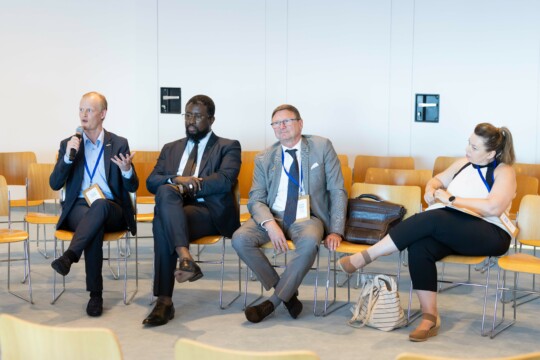
Mr. Maram Kaire, Director General of the Senegalese Space Agency (ASES), presented one of the session’s most compelling success stories. As a new oil and gas producer, Senegal faces growing challenges related to illegal fishing, maritime trafficking and the protection of offshore infrastructure. To strengthen maritime surveillance, the country is working with Prométhée, Unseenlabs and the national armed forces to detect suspicious vessels, including those operating without active tracking systems. Environmental monitoring is another priority, particularly the detection of harmful algal blooms through a new platform developed with Grogenics. At the same time, the country is rapidly building its first satellite constellation.
Beyond technology, Mr. Maram Kaire stressed that communication is the greatest challenge for emerging space nations. Convincing governments to invest requires demonstrating concrete benefits for citizens. “Space is not a luxury,” he explained, emphasising that applications in agriculture, healthcare, education and maritime security are far more persuasive than scientific reports alone.
Ms. Lilian Anne Krug, scientific coordinator at the Partnership for Observation of the Global Ocean (POGO), highlighted the organisation’s work in capacity building across its members. While Earth observation has revolutionised ocean monitoring (illustrated by the Argo programme) satellite data cannot replace in situ observations, which remain essential for calibration. Long-term funding, however, continues to be a major obstacle, as political cycles rarely align with the needs of sustained scientific observation. She also underlined the value of local partnerships, citing examples where scientists and fishermen worked together to strengthen coastal monitoring.
From the hydrographic perspective, Mr. Mathias Jonas, Secretary General of the International Hydrographic Organization (IHO), emphasised the critical role of international standards. Although often overlooked, standardisation ensures that ocean data collected worldwide are compatible and operationally useful. He also argued that successful observing systems must respond to users’ needs, summarising the approach with: “Standardise globally, apply locally.” Regional cooperation, he added, is often the most effective way to implement global standards.
Representing the Maldives Space Research Organisation (MSRO), Mr. Emil Luth highlighted the specific challenges faced by small island states, where limited resources require careful prioritisation of monitoring efforts, from ocean currents and seagrass to fisheries and biodiversity. Collaboration, investment and sustainable financing are essential to support long-term environmental observation.
A recurring theme throughout the discussion was the importance of explaining the value of space technologies. Moderator Ms. Zaklin Butinar, Interim Secretary General of Eurisy, noted that governments often struggle to justify investments without clear cost-benefit analyses. Mr. Maram Kaire responded that understanding must come before funding: once decision-makers recognise the practical value of the space sector, financial support naturally follows.
Following questions and comments from the audience, the discussion concluded that successful space-ocean initiatives depend not only on technological innovation, but also on international cooperation, capacity building, long-term investment and effective communication. As broadband connectivity at sea expands, new opportunities for real-time ocean monitoring are emerging, reinforcing the growing role of space technologies in supporting sustainable and secure maritime activities.
During the many coffee breaks throughout the day, participants had the opportunity to exchange with a wide range of stakeholders from both the space and ocean sectors. Bringing together such diverse profiles created opportunities for discussions and connections that would not have happened otherwise.
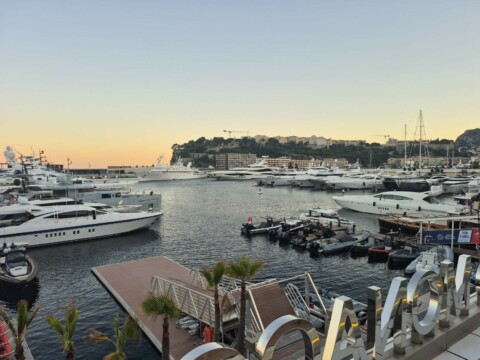
The event concluded with a networking cocktail at the Société Nautique / Yacht Club de Monaco, allowing all participants to continue their discussions over a convivial buffet and to close the day in a privileged setting, on the port of the Principality.