
Eurisy co-hosts a new European forum putting society at the heart of the space debate

Eurisy co-organised the first edition of Space Debate Europe with ESA and ESPI, contributing to the development of a new European dialogue format and bringing together space and non-space stakeholders for an open exchange on the future of Europe’s space sector. The event took place on 22-23 September in the historic Palacio de Linares in Madrid, with the Spanish Space Agency acting as governmental sponsor. It was held within the Interparliamentary Space Conference, chaired by Spain in 2026.
The unique event offered a multi-dimensional perspective on space, bringing together political, industrial, strategic and societal perspectives. The new approach aimed to broaden the conversation beyond the space sector itself and highlight the connections between space activities and wider markets, societal challenges and opportunities. Bringing society to the heart of the conversation, Eurisy led the Society Track, “Seeing the Unseen: Space at the Service of Society.” The track brought a distinct, society-centred perspective to the programme, creating a platform for societal voices, experiences and needs that are often underrepresented in traditional space events.
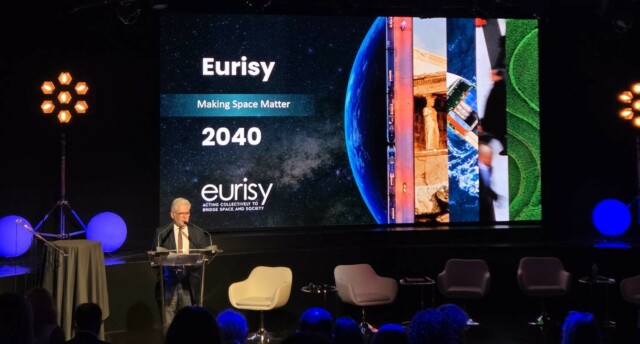
The Society Track opened with a keynote address by Eurisy President Eric Morel de Westgaver, marking his first speech in this new capacity. During his remarks, he officially unveiled Eurisy’s 2040 Strategy, outlining a vision for the association’s future and its mission to strengthen the connection between space and society under the banner “Making Space Matter.”
Access the Eurisy 2040 Strategy here
“Eurisy was born in 1989. Back then, for most Europeans, space was science fiction. Space was Star Wars at cinema. (…) Today space is not out there. It is right here.” (Eric Morel de Westgaver)
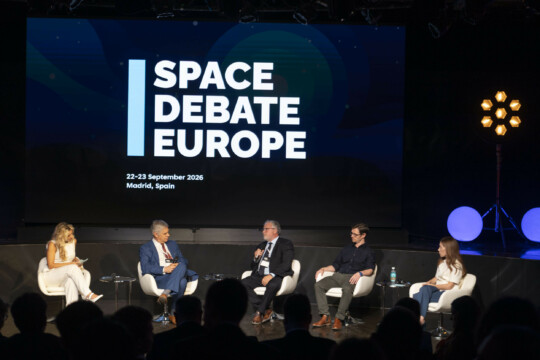
Europe’s water challenges took centre stage, with the discussion focusing on one of the defining challenges of our time through three interconnected dimensions: too much, too little and too toxic water. Moderated by Žaklin Butinar, Eurisy Interim Secretary General, the panel “Water Under Pressure: Too Much, Too Little, Too Toxic” brought together experts representing each of these critical perspectives. Pierpaolo Campostrini, Managing Director of the Consortium for Managing Research Activities in the Venice Lagoon, addressed the challenges of too much water, presenting the case of Venice and the systems supporting its conservation, with satellite data helping to track changes in water levels and land subsidence across the lagoon.
Jenő Lábdy, Head of the International Department at Hungary’s General Directorate of Water Management, explored the realities of too little water, focusing on the episodes of drought experienced along the Danube past summer and how satellite observations can provide a basin-wide picture of water availability, surface water extent and drought impacts. To conclude, James Doherty, Founder and CEO of Poseira, focused on their space solutions to monitor water toxicity in Lough Neagh in Northern Ireland, showing how satellite imagery can reveal changes in water quality from orbit, including the extent and evolution of algal blooms and other indicators of pollution.
Carmen Aguilera Rios, Head of the Operational Market Development and Critical Applications Section at EUSPA, highlighted the role of space-based technologies and data in monitoring water-related challenges and supporting more informed and resilient responses.
Key Takeaways
- Close the gap: The real challenge is turning data into actionable information for water managers, mayors, responders and communities.
- Connect Europe’s capabilities: Local needs, regional challenges and European space assets must work together to turn observation into action.
The second panel of the track, “Protecting Cultural Heritage in Conflict: The View from Space”, focused on cultural heritage and brought together experts from space and cultural domains.
Held in the spirit of the Memorandum of Cooperation and Partnership signed in early 2026 between the Ukrainian Minister of Culture Tetyana Berezhna and Spanish Minister of Culture Ernest Urtasun, the discussion brought both perspectives together, reaffirming a shared commitment to protecting cultural heritage and strengthening cooperation. The discussion opened with a keynote address by Mr Urtasun, who stressed the importance of preparedness and of adopting a more preventive and forward-looking approach to the challenges ahead.
From left to right: Spanish Minister of Culture Ernest Urtasun, Eurisy President Eric Morel de Westgaver, Yuliia Sokolovska, Ambassador Extraordinary and Plenipotentiary of Ukraine to the Kingdom of Spain.
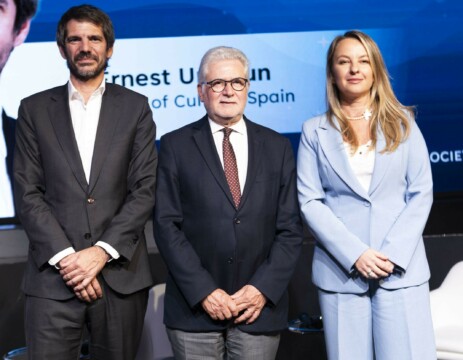
“We must move from reacting to damage towards a more preventive approach. This is essential to protecting our cultural heritage from both climate change and conflict threats: different challenges, but the same need to anticipate risks, act earlier and cooperate. Earth observation can provide the tools to make this possible”. (Ernest Urtasun)
Yuliia Sokolovska, Ambassador Extraordinary and Plenipotentiary of Ukraine to the Kingdom of Spain, shared Ukraine’s perspective on the urgent need to protect cultural heritage threatened by the ongoing conflict, underscoring how satellite-based observations provide access to otherwise unreachable sites and enable informed action to document, protect, and preserve cultural heritage.
“In Ukraine, cultural heritage is threatened not only by attacks and physical destruction, but also by illegal excavations and the removal and trafficking of cultural objects. Space allows us to see beyond distances and front lines, including places that are currently beyond our reach. Our task is to turn this information into concrete action: to document, protect, cooperate and, ultimately, preserve.” (Yuliia Sokolovska)
The debate continued with Charlotte Fafet, User Engagement and Partnership Associate at ECMWF, highlighting how Copernicus climate and atmosphere data can help cultural heritage professionals shift from responding to damage to anticipating and mitigating climate-related risks. Emphasising the importance of closer collaboration with the heritage sector, she called for the co-design of services that meet practitioners’ needs and integrate seamlessly into existing heritage management workflows.
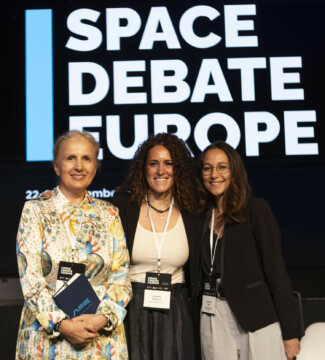
From left to right: Anna Sidorenko, Jolanda Patruno, Charlotte Fafet.
Anna Sidorenko, Head of the Cultural Heritage Protection Treaties Unit at UNESCO, complemented this with a focus on international coordination and collective action, highlighting how shared frameworks and expertise can connect stakeholders and turn individual initiatives into a coordinated international response. Jolanda Patruno, Capability Support Engineer at ESA, moderated the discussion.
A curated selection from “Behind the Lens: Culture Under Attack,” an exhibition developed by Ukraine’s Institute of Mass Information with the support of UNESCO, was displayed at the venue alongside the panel. It featured powerful work by Ukrainian journalists and photographers documenting the damage to churches, theatres, libraries, museums and other cultural sites caused by Russia’s aggression.
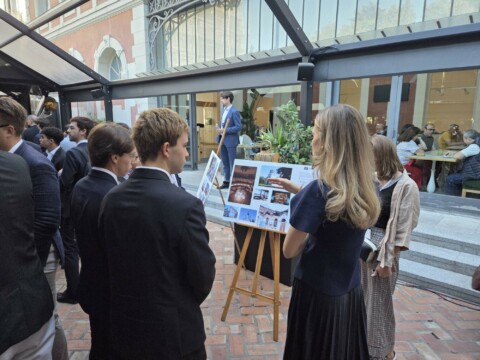
These photographs showed what satellites alone cannot: the human cost of destruction. They made tangible for attendees what is lost when culture comes under attack, and why protecting it matters.
Shared Goals and Future Ambitions
- Move beyond monitoring: Develop capabilities not only to monitor cultural heritage, but also to alert, prevent, and support recovery when threats occur.
- Co-design tools with users: Invest in the development of practical tools together with end users and the cultural heritage community, ensuring that solutions respond to real needs and can be effectively integrated into existing practices.
- Broaden the scope of cultural heritage: Expand the use of space-based technologies beyond physical sites and monuments to better address intangible cultural heritage.
The discussions brought together perspectives from across the space, climate, cultural heritage and policy communities, highlighting the importance of dialogue between space and non-space actors in addressing societal challenges. Through the Society Track, Eurisy contributed to a broader conversation about how space can respond to societal needs and how society, in turn, can help shape the future of the European space sector.
The event concluded with the signing of a Memorandum of Understanding between Eurisy and the European Space Policy Institute (ESPI), outlining a shared framework for future activities and collaboration. More details here.
As Europe’s space ambitions grow, Eurisy will keep working to make space matter for the communities it serves.
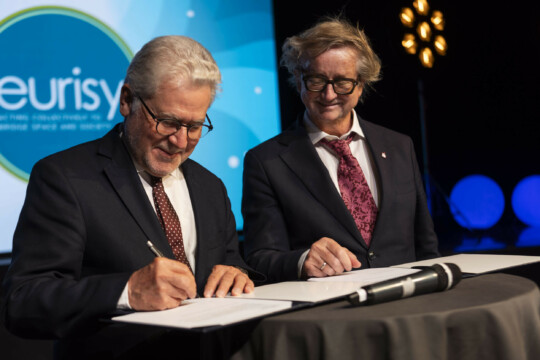
Eurisy President Eric Morel de Westgaver & Ludwig Moeller ESPI Director