
From Disruption to Dialogue: Space Assets for Maritime Security at the Atlantic Centre Conference
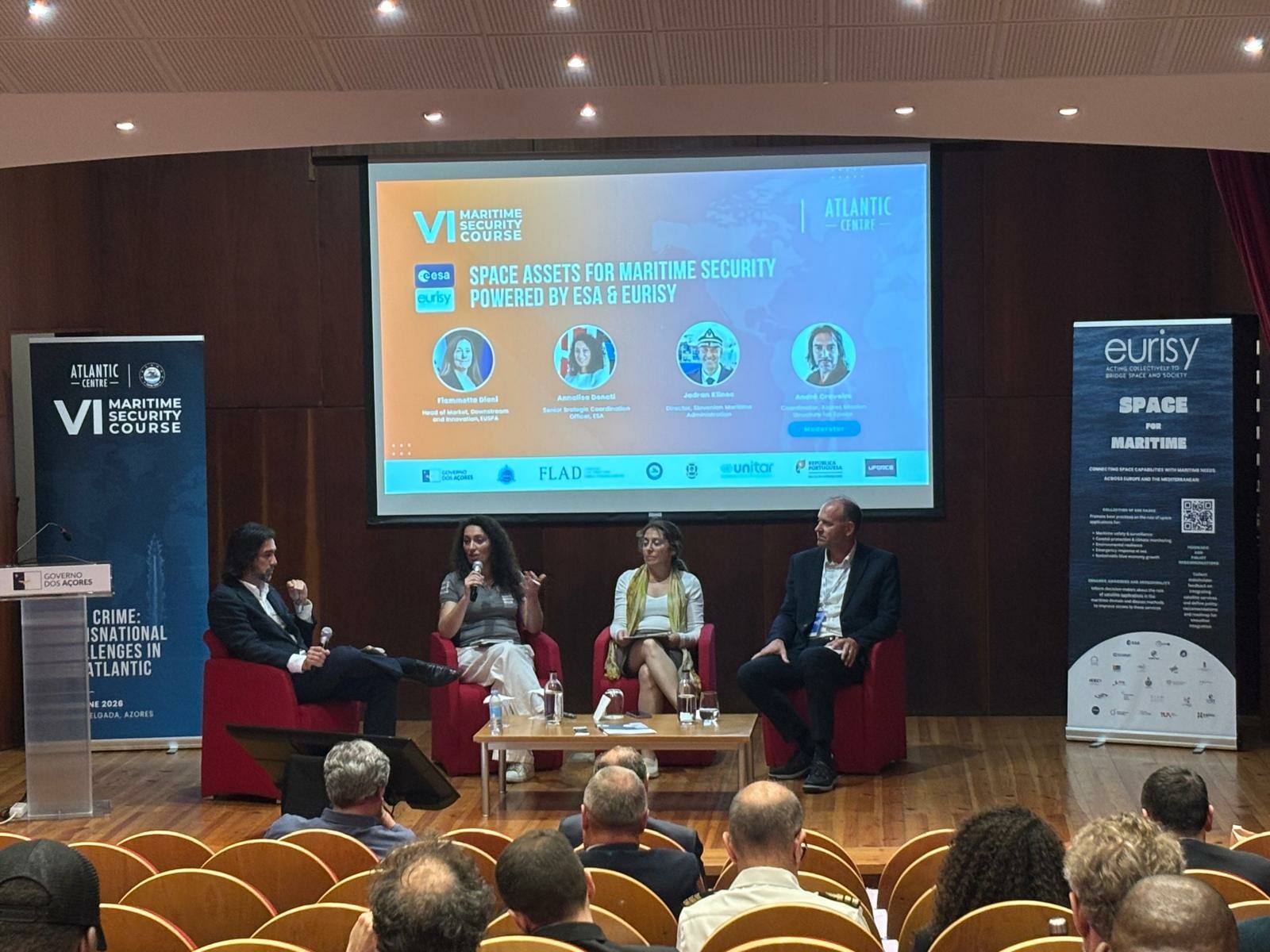
The Space for Maritime Security Workshop, organised by ESA and EURISY in Ponta Delgada, was designed to bring together stakeholders from the maritime and space sectors to explore how space-based capabilities can support maritime security, safety and resilience. The workshop was set to examine the contribution of Earth Observation, satellite navigation and satellite communications to addressing operational challenges in the Baltic Sea and Oversea territories, while fostering dialogue between technology providers, institutional actors and end users.
Due to adverse weather conditions and travel disruptions affecting the Azores, the workshop had to be postponed to the 7 and 8 September 2026 – if you would like to participate, you can learn more here and register here. However, the presence of several speakers and participants on the island created an opportunity to engage with the Atlantic Centre’s VI Maritime Security Course Conference, held under the theme “Blue Crime: Transnational Challenges in the Atlantic.”.
Within this framework, a panel entitled “Space Assets for Maritime Security” was organised by Eurisy as part of the Atlantic Center’s conference programme. Moderated by André Craveiro, Coordinator of the Azores Mission Structure for Space, the panel brought together Fiammetta Diani, Head of Market Downstream and Innovation at EUSPA; Annalisa Donati, Senior Strategic Coordination Officer at ESA; and Jadran Klinec, Director of the Slovenian Maritime Administration, who contributed the operational user perspective.
Although the conference was not originally intended to cover space-related topics, it offered a valuable opportunity to introduce space-based capabilities to a maritime security audience. Many participants were unfamiliar with key European programmes and services such as Copernicus, Galileo and IRIS², underlining the importance of strengthening awareness of how space assets can support maritime operations and decision-making
The discussion explored how space-based systems are becoming increasingly central to maritime awareness and operational response in an evolving threat landscape, including illicit trafficking, piracy, irregular migration, environmental risks and the protection of offshore infrastructure.
Earth Observation, satellite navigation and satellite communications were highlighted as key enablers of maritime security, extending coverage and connectivity across vast ocean areas where terrestrial systems are limited or unavailable. These capabilities support vessel tracking, detection of suspicious activity, search and rescue operations, environmental monitoring and more effective situational awareness for decision-making.
A key takeaway from the panel was that space is not a standalone solution, but a force multiplier. Its value is maximised when combined with other data sources – such as AIS, drones and operational intelligence – and translated into actionable insights for end users. The discussion also reinforced the importance of cooperation, information sharing and user training, alongside the need for legal and institutional frameworks to evolve in step with technological progress.
While the workshop itself could not take place as originally planned, the exchange at the Atlantic Centre Conference demonstrated the strong synergies between the maritime and space sectors. The panel served not only as a forum for dialogue, but also as an effective bridge between space experts and potential users, helping to connect operational needs in the maritime domain with existing space-based solutions. It provided a valuable opportunity to share perspectives, showcase current developments and reinforce a common understanding of how space assets can support the security, safety and resilience of the maritime domain.