
GEO-Academy International Conference in Paris
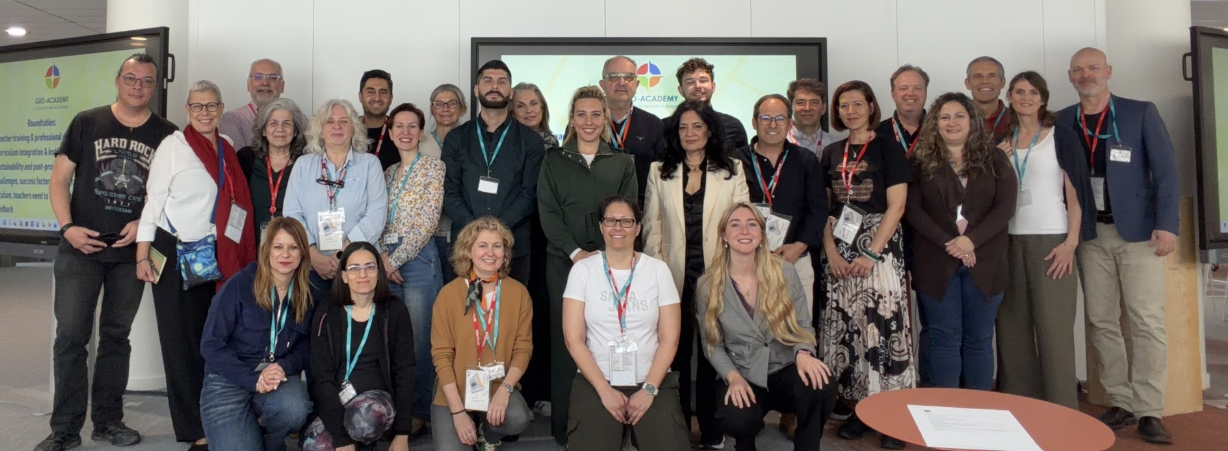
From 27 to 29 April 2026, Eurisy organised the GEO-Academy International Teachers Conference at the European Space Agency Headquarters (ESA HQ Daumesnil) in Paris, France, bringing together teachers, researchers, institutional representatives, sustainability experts and geospatial education stakeholders from across Europe.
As one of the final major milestones of the GEO-Academy project, the conference provided an opportunity to reflect on three years of collaboration dedicated to strengthening geospatial education, Earth Observation (EO), GIS and sustainability learning in schools. Participants from Austria, Portugal, Cyprus, Greece, Sweden, Bulgaria and France joined the event alongside representatives from ESA, COSPAR, Esri UK and GEO-Academy partner organisations.
The conference opened with keynote sessions featuring several high-level speakers from the European space and education ecosystem. Kai-Uwe Schrogl, ESA Special Adviser for Political Affairs and former President of the International Institute of Space Law, highlighted the growing importance of spatial literacy and geospatial education within Europe’s future education and space strategies. Jean-Claude Worms, Executive Director of COSPAR, emphasized the importance of international scientific cooperation and the need to translate Earth Observation knowledge into societal value through education and outreach.
Throughout the conference, GEO-Academy partners showcased the project’s main achievements, including the development of the GEOBSERVE platform, GEO-Hubs, teacher training modules and practical educational resources designed to support the integration of geospatial technologies into classrooms.
The second day of the conference focused strongly on panel discussions dedicated to the future of GEO-education and the transformation of classroom practices.
The first panel, “Building Tomorrow’s Educators: Emerging Competence Needs in GEO-Education”, moderated by Dr. Loukas Katikas, brought together Claire Evans from Bloxham School, Katie Hall from Esri UK, Clara Cruz Niggebrugge from ESA and Olympia Befa from Ellinogermaniki Agogi.
The discussion explored the future competencies required for teachers and students in an increasingly data-driven and sustainability-focused world. Panelists highlighted the importance of spatial thinking, GIS literacy, inquiry-based learning and the integration of authentic Earth Observation data into classrooms. Katie Hall and Claire Evans notably stressed that the challenge today is not the lack of geospatial tools, but rather curriculum integration, teacher confidence and institutional support. Clara Cruz Niggebrugge also emphasized ESA’s long-term vision for Earth Observation education and the importance of preparing future generations for careers and societal challenges linked to climate and sustainability.
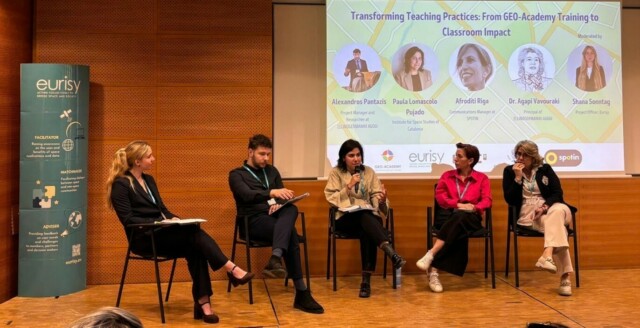
The second panel, “Transforming Teaching Practices: From GEO-Academy Training to Classroom Impact”, moderated by Shana Sonntag from Eurisy, focused on the concrete implementation of GEO-Academy methodologies in schools.
Alexandros Pantazis from Ellinogermaniki Agogi, Paula Lomascolo from the Institute for Space Studies, Afroditi Riga from SPOTIN and Evgenia Agapi Vavouraki discussed how teacher training can move beyond isolated workshops to become long-term educational transformation. The discussion highlighted the importance of continuous mentoring, modular educational resources, school leadership support and collaborative ecosystems enabling teachers to adapt geospatial approaches to their own classrooms.
One of the highlights of the event was the GEO-Academy GeoVoices Map Storytelling Competition, which demonstrated how students can combine digital storytelling, mapping technologies and sustainability topics to better understand their local environment.
The winning project, “Sustainable Community Living in our School and Beyond”, was presented by students from Agios Spyridonas Lyceum in Limassol, Cyprus. Their work explored how local school initiatives can contribute to broader sustainability goals through geospatial storytelling and community engagement.
Additional projects showcased during the conference included:
- “The Rivers of Our Areas” by Eleni Korakaki;
- “Changing the End: A Map Storytelling Project” by the 3rd Junior High School of Argyroupoli;
- a Map Storytelling Project developed by Evgenia Tsioupli and Lemonia Laskari from the 1st Model High School “Manolis Andronikos”;
- and the Award Ceremony Project by Victoria Marques from Agrupamento Terras do Ave European School in Portugal.
More information about the GeoVoices competition and the participating projects is available on the GEO-Academy website:
A major focus of the conference was also placed on teachers’ presentations and classroom implementation. Teachers from across Europe presented concrete educational activities developed through GEO-Academy training and demonstrated how geospatial technologies are already being integrated into schools.
Philippe Longchamps from Sweden presented a field study in which students mapped noise pollution around their school using ArcGIS Online and geolocated field data before proposing mitigation strategies linked to urban sustainability. Ana Rola from Portugal showcased projects on urban heat island mitigation and Nature-Based Solutions using StoryMaps and Copernicus data adapted to local contexts.
In Austria, Julia Haidacher introduced a teaching sequence on bark beetle infestations and forest health using interactive climate and mapping tools, while Thomas Flatscher presented an innovative “Geodesign” project combining laser scanning, 3D modelling and digital landscape representation.
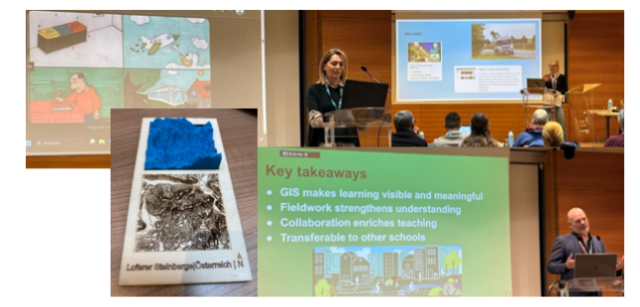
Teachers from Cyprus also shared interdisciplinary STEM projects combining geospatial tools, drone simulations, coding and wildfire prevention scenarios. Charalambos Charalambous demonstrated how students used Google Earth, Scratch programming and mathematical modelling to explore forest fire prevention and environmental awareness.
Additional presentations highlighted robotics workshops, outdoor environmental education and inquiry-based sustainability projects. Hélio Domingues from Portugal shared student-centred activities focused on wildfire prevention and environmental stewardship, while Eva Axheden from Sweden demonstrated how outdoor learning activities using the GEOBSERVE platform support experiential environmental education.
Olympia Befa and Evgenia Agapi Vavouraki from Greece also presented projects linking sustainability education, biodiversity exploration and spatial thinking through inquiry-based learning activities implemented in both primary and secondary education.
Rather than discussing GEO-education in abstract terms, these presentations showcased concrete classroom applications already tested in schools and demonstrated how students engage directly with real environmental and societal challenges using Earth Observation data and geospatial technologies.
Beyond the conference sessions themselves, the event generated strong visibility online and across professional networks. Participants, keynote speakers and teachers actively shared conference highlights on LinkedIn, contributing to increased engagement around GEO-Academy and geospatial education. During the conference, GEO-Academy gained more than 50 new LinkedIn subscribers, while conference-related posts reached hundreds of users and were reposted by speakers and participants across Europe.
Pictures and highlights from teachers’ presentations, student projects and panel discussions further contributed to showcasing the diversity and concrete impact of GEO-Academy activities in classrooms and educational communities.
As one participant noted:
“The GEO-Academy event held in May 2026 in Paris, at the headquarters of the European Space Agency, was exceptionally well organized by EURISY. Their professionalism and attention to detail played a key role in making the event an outstanding success, bringing together participants from across Europe to explore a wide range of engaging and thought-provoking topics. GEO-Academy embodies the future of geographical education: collaborative, innovative, and deeply rooted in the real challenges facing our planet. It is an essential initiative, connecting experts, educators, and learners around a shared goal to better understand our world in order to protect it more effectively.”
The GEO-Academy International Teachers Conference ultimately confirmed the emergence of a growing European ecosystem connecting education, sustainability and space-enabled technologies, while empowering teachers and students to use geospatial tools to better understand and address today’s environmental challenges.